Helicopter Safety FAQs
Straight answers about beginner helicopter safety, Cabri G2 training, emergency landings, autorotations, maintenance, and instructor experience.
Read the Safety GuideHelicopter Safety FAQ
Common Questions About Training Safety
Yes, helicopter training can be safe for beginners when it is built around the right aircraft, experienced instructors, careful maintenance, weather judgment, and progressive instruction. TruFlight trains students in the Guimbal Cabri G2 and introduces safety procedures from the first lesson.
Helicopter training is designed to manage risk through structured lessons, preflight inspections, checklist discipline, emergency procedure training, and instructor supervision. Students do not begin with advanced maneuvers. They build control, awareness, and decision-making step by step.
No. This is one of the most common helicopter safety myths. If a helicopter loses engine power, the pilot can enter an autorotation, which keeps the rotor system turning during descent and allows the aircraft to remain controllable for landing.
Helicopters are trained and operated with engine-failure procedures in mind. Through autorotation, a competent pilot can keep the aircraft controllable and select a suitable landing area. Helicopters can often use smaller clear areas than airplanes, which typically need more runway-like space.
An autorotation is a helicopter emergency procedure used after power loss. Airflow through the rotor blades keeps the rotor turning while the pilot manages airspeed, rotor rpm, landing area, and touchdown. It is a core part of helicopter emergency procedure training.
Students can be introduced to multiple autorotation profiles as they progress, including straight-in autorotations, pedal-turn autorotations, 180-degree autorotations, and 360-degree autorotations. The exact timing depends on the student's certificate level, readiness, and instructor judgment.
Helicopters and airplanes have different safety profiles. Airplanes usually need runway-like landing space, while helicopters can often land in smaller, unprepared areas. The safer choice depends on the mission, aircraft condition, pilot training, weather, and decision-making.
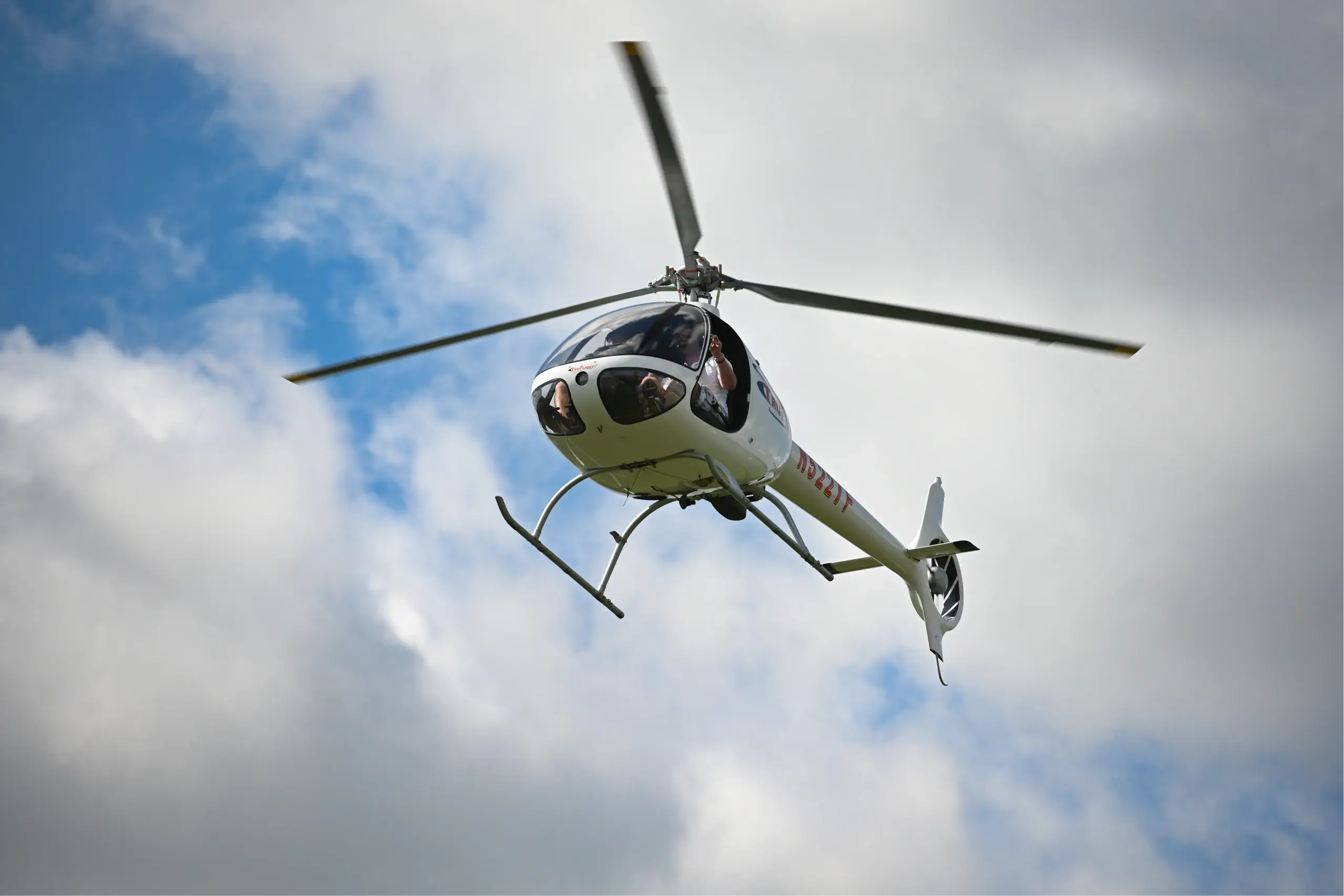
The Guimbal Cabri G2 includes safety-focused features such as a crash-resistant fuel bladder/cell, carbon fiber body, stroking seats, stable handling, modern cockpit visibility, and system monitoring. TruFlight uses the Cabri G2 because it is designed for modern helicopter training. See our Cabri G2 fleet.
Crash survivability depends on many factors, including impact forces, landing attitude, terrain, pilot action, seat and structure design, fuel system design, and response after landing.
The Cabri G2, the model of our main helicopters, is designed with occupant protection as a priority, its central structure and energy-absorbing seats were developed and certified-tested for vertical impacts, with proof that occupants would survive a 2,000 ft/min impact, equivalent to a 5-meter free fall. In a hard vertical landing where the skids hit first, the Cabri's landing gear, composite structure, stroking seats, and crash-resistant fuel cell all help manage impact energy.
However, even with this in mind, it is important to be aware that no aircraft can guarantee a specific outcome in every accident.
The Cabri G2, the model of our main helicopters, is designed with occupant protection as a priority, its central structure and energy-absorbing seats were developed and certified-tested for vertical impacts, with proof that occupants would survive a 2,000 ft/min impact, equivalent to a 5-meter free fall. In a hard vertical landing where the skids hit first, the Cabri's landing gear, composite structure, stroking seats, and crash-resistant fuel cell all help manage impact energy.
However, even with this in mind, it is important to be aware that no aircraft can guarantee a specific outcome in every accident.
TruFlight treats instructor experience as a core safety factor. All CFIs hired by TruFlight are high-hour pilots with real-world experience. Todd Guison, our chief instructor, is a high-hour CFI and former combat aviator with Army aviation experience, Blackhawk experience, a CFII certificate, an S70 type rating, Part 133 experience, HAMETS training, and an Army Safe Flying Award.
Interested in learning more? Meet Our Pilots.
Interested in learning more? Meet Our Pilots.
In Class G airspace, pilots are not always required to use the radio. At TruFlight, students still train with disciplined radio communication and treat every airspace environment as if it were towered. That habit helps pilots stay ahead of traffic, communicate clearly, and feel prepared when moving between uncontrolled and controlled airports.
TruFlight has a Guimbal factory-trained mechanic, is actively hiring additional mechanics, and can perform Cabri G2 maintenance and warranty work in-house. That in-house capability helps keep maintenance knowledge close to the aircraft students train in.
A discovery flight is designed for first-time flyers and aviation-curious guests. An instructor leads the experience, explains the aircraft, and manages the flight environment. If you want to see the aircraft and ask safety questions in person, start by scheduling a discovery flight.
Still Unsure About Helicopter Safety?
Contact us directly, and we'll answer your questions so you can feel confident and informed about helicopter safety.